CASE FILE · KM-07

Chaos as Revenue.

Management wanted the Tipton Hotel to go adults-only to escape the chaos of kids running the halls. The booking data said those same families were the hotel’s highest-value guests.

R & TidyverseData Cleaning & SegmentationExploratory Data AnalysisComparative Revenue AnalysisData VisualizationTeam Collaboration
Case File Snapshot
StakeholderData Wrangling Course, Final Team Project Framing: Fictional Client "The Tipton Hotel"
Role3-Person Team: Led Problem Framing & Analytical Approach Owned the Adult/Family Segmentation and All 5 Major Revenue Driver Analyses
DatasetHotel Booking Demand Dataset • 33 Variables, 86,416 Observations Filtered to City Hotel: 47,819 Adult-Only, 5,001 Family Bookings
MethodData Cleaning & Segmentation, Comparative Revenue Analysis in R
OutputsFinal Team Presentation, RMarkdown Analysis Script
Applied ValueTurns an anecdotal complaint about noisy guests into a revenue-backed staffing and amenity recommendation
The Story
The Question

Could the Tipton Hotel go adults-only without hurting revenue, or were the guests generating the most complaints also the guests generating the most money?

The Tension

Management’s read on the problem was pure friction: kids in the lobby, parking chaos, guests running wild. But annoyance isn’t the same as unprofitability, and nobody had actually compared what family bookings paid against what they cost in patience.

The Insight

Every revenue driver we checked pointed the same direction: families out-spent adults, not the other way around.

The System

The recommendation held up because four decisions kept the comparison honest:

  • Property MatchFiltered to City Hotel bookings only, since the Tipton is an urban property, not a resort.
  • Segment DefinitionSplit bookings strictly by presence of children or babies, not by loyalty tier or price alone.
  • Multi-Metric ComparisonChecked average daily spend per guest, meal-package rate, special requests, and repeat-stay rate before drawing a conclusion from any single number.
  • FramingTreated "chaos", special requests and kids in common areas, as a data point to test, not a foregone conclusion.
The Approach
01Problem FramingReframed the complaint about noisy guests into a testable question: does excluding families actually protect revenue?
02Analytical Approach DesignDefined the segmentation and comparison variables, cancellations, loyalty, average daily spend per guest, meals, special requests, ahead of touching the data.
03Data Cleaning & FilteringRemoved duplicates and redundant variables, then filtered to City Hotel bookings so results reflected the Tipton’s urban setting.
04SegmentationWrote the grouping logic that split the cleaned dataset into adult-only and family bookings: 47,819 vs. 5,001 City Hotel reservations.
05Exploratory Data AnalysisBuilt all five comparative revenue-driver analyses: average daily spend per guest, estimated revenue per booking, meal-package mix, loyalty, and special-request rates across both segments.
06Data VisualizationBuilt boxplots, bar charts, and donut charts in R to make each revenue gap visible at a glance for a non-technical stakeholder.
07Recommendation DevelopmentTranslated the revenue gap into three operational recommendations instead of the cut leadership had proposed.
Tools (Secondary)
RTidyverseRMarkdown
Key Findings
InsightEvidenceStrategic Meaning
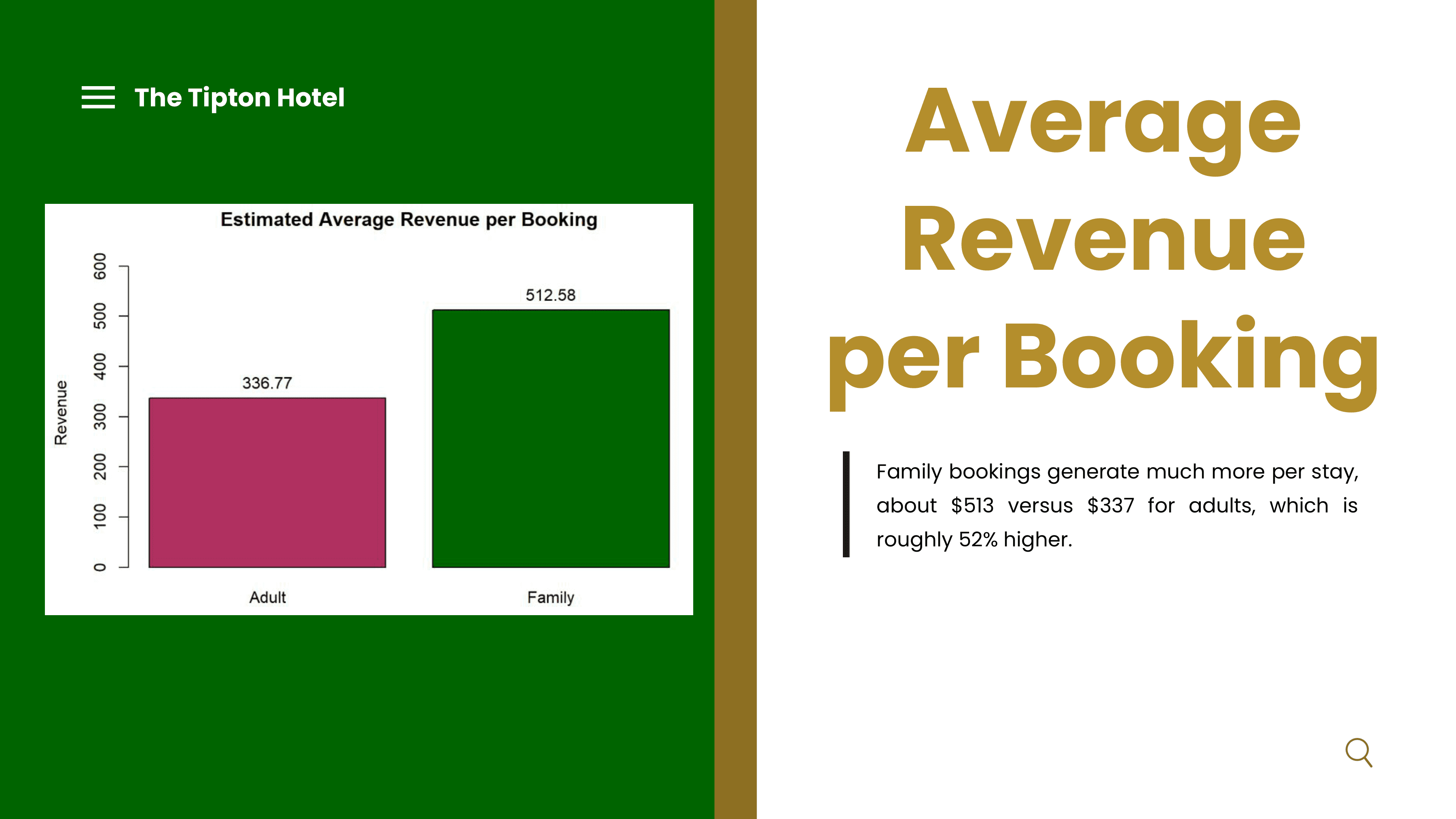
Family bookings out-earned adult-only bookings by over 50% per stay.EvidenceFamily bookings averaged $512.58 in estimated revenue per booking, versus $336.77 for adult-only bookings.Strategic MeaningThe guests management wanted to cut were the higher-spending half of the business.
Families bought more of the add-ons that pad margin.Evidence88.1% of family bookings included a paid meal package (breakfast, or breakfast plus one more meal) versus 77.7% for adults, and only 4.4% of families skipped meals entirely versus 17.3% of adults.Strategic MeaningMeal packages are a margin lever families pulled far more consistently than adults did.
Family bookings generated more special requests, a signal of engagement, not just noise.Evidence61.4% of family bookings included a special request, versus 49.5% of adult-only bookings.Strategic MeaningWhat reads as "high-maintenance" day to day is also a sign of guests invested in the stay.
Adults were more loyal, but families still showed up as repeat guests.EvidenceOver 30% of adult-only bookings had 5+ prior stays, while over 50% of family bookings had at least 1 prior stay.Strategic MeaningAdults are a smaller, more loyal core. Families are a larger base that keeps coming back, not a one-time inconvenience.
Output Preview
Bar chart comparing estimated average revenue per booking: $336.77 for adult bookings vs. $512.58 for family bookings
Average Revenue per Booking · 1/3
Recommendations
Keep Family Bookings, Don’t Cut Them
Families spend 52% more per booking, buy more meal packages, and return at a healthy rate. Cutting them would trade real revenue for a management headache.
Create a Supervised Family Zone
Contain the disruption with a dedicated family zone, supervised activities, and a clear daily schedule, instead of removing the guests who fund it.
Bundle to Lock In Spend, Wall Off Quiet Hours
Pair rooms with breakfast, parking, and late checkout to make family spend predictable, and designate quiet floors and hours to protect guests who came for adult-only calm.

Selected slides from the final Tipton Hotel team presentation.

Ask Me About This Project →