Combination as Compromise.
Three models tried to catch COVID-19 from a cough recording. The one built to combine them looked strongest on paper, and weakest at the one job that mattered: catching real cases.
Traditional COVID-19 testing is slow, costly, and hardest to reach for under-resourced communities. Could a cough recording alone stand in for a clinical read, or does it need one?
The obvious hypothesis was that more signal wins: pair what a doctor hears in a symptom history with what a model hears in the audio, and get a better diagnosis than either alone. That combination scored close to the baseline model overall, and worse than the audio model at the one job that mattered.
The best model on paper wasn’t the best model at catching real COVID cases.
The pipeline held together on four decisions:
- Consensus Labeling — Physician ratings were combined by median (numeric) or mode (categorical) across up to 4 raters per cough.
- Strict Balancing — Healthy and symptomatic cases were undersampled to match the smaller COVID-19 count, so no class could win on volume alone.
- Paired Modalities — Every case kept its audio and metadata rows aligned 1-to-1, so the same patients fed both models.
- Stacking, Not Averaging — The combined model learned from each model’s full probability vector, not just a simple vote or average.
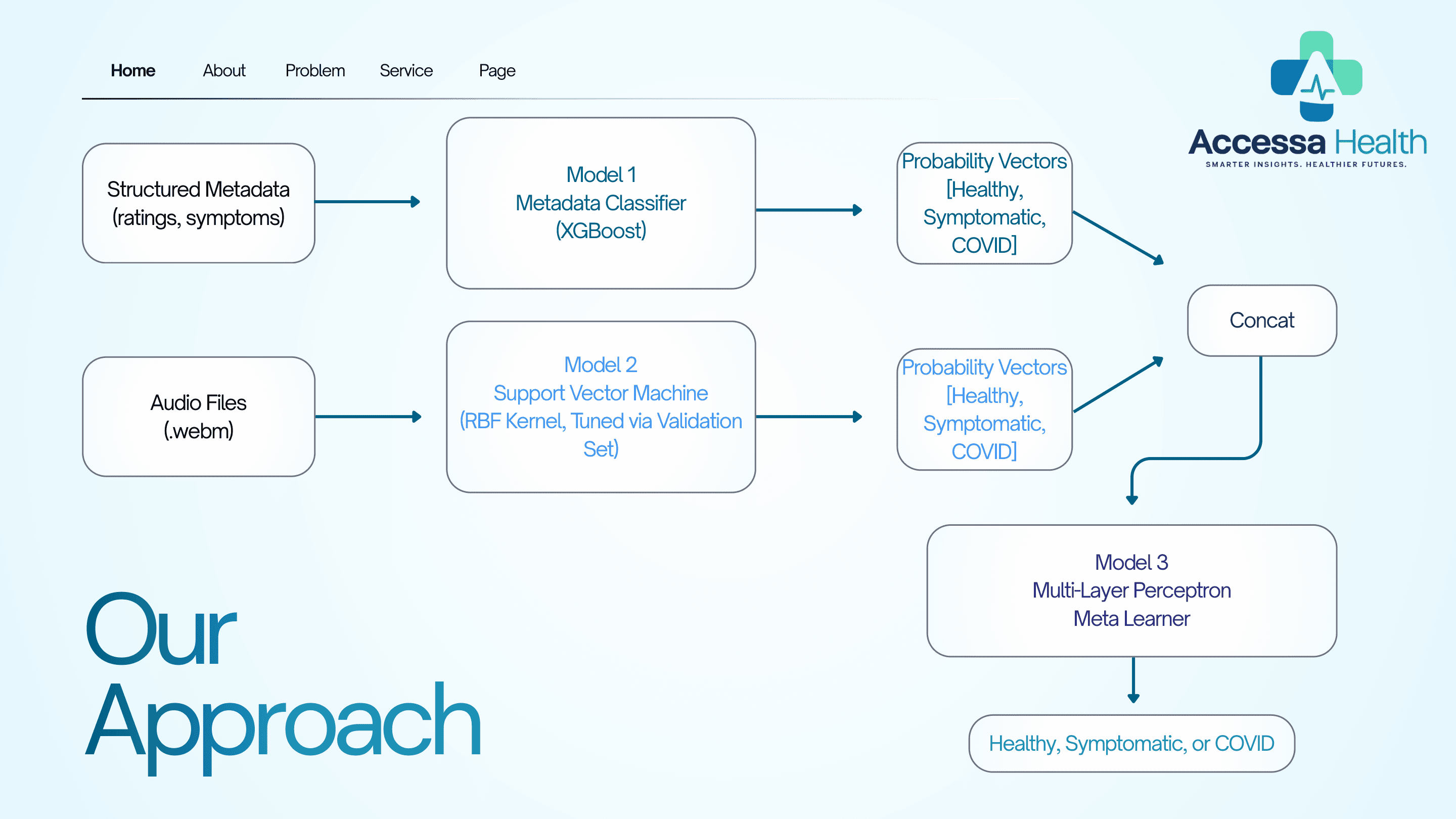
Selected slides from the final CoughDx presentation.
Ask Me About This Project →